![[personal profile]](https://www.dreamwidth.org/img/silk/identity/user.png) mightymads posting in
mightymads posting in ![[community profile]](https://www.dreamwidth.org/img/silk/identity/community.png) victorian221b
victorian221bThe second book about ACD I read with great interest was Arthur Conan Doyle: A Life in Letters, a collection of his letters to his mother Mary Doyle, whom he wrote regularly throughout his entire life, since he was a little boy and until her death in 1920, just ten years before ACD passed away himself. Unlike the memoirs, where ACD had to maintain a public image, the letters were not meant for anyone else but the addressee, so they offer an even deeper insight into ACD’s personality. Very often the memoirs and the letters compliment each other like pieces of the puzzle. By comparing them, one can notice what ACD preferred to be silent about or what was a deliberate mystification.
Two examples out of many: 1) In the discussion of the memoirs,orchid314 left a very astute comment, saying that “a child of an alcoholic learns to conceal from an early age”. That’s precisely what happened: while in his memoirs ACD speaks openly about being severely beaten by the schoolmasters, in the letters he hardly ever mentions that something is amiss. On the contrary, he constantly assures his mother that everything is all right and asks her not to worry. One good reason for that was the teachers reading their pupils’ letters, but ACD must have also keenly sensed the difficult situation at home (it was so dire that he had to stay at school for Christmas while other boys went home for vacation), and hence he spared his mother’s feelings.
2) It is from the letters that one learns the true circumstances of ACD’s choosing literature over medicine, and that it was not for the lack of patients, but rather because of his exhaustion (as already mentioned in the previous post).
The book is also fascinating because one can trace how a child (with simplistic grammar, spelling errors, and naïveté) evolved into a youth, and then into a grown man. There one can see very human moments which help one perceive ACD not only as a literary figure, but as a living being who liked to have fun and could do silly things:
The poignant and heartbreaking letters of the WWI period gave me a sense of ‘immediacy’, and for the first time I could regard it not as a far away historical event but a real tragedy in the lives of many people. After reading this book I think that there is no better way to learn history than to touch it through the letters.
Some traits of ACD’s character I admired and some found perplexing to say the least. The complexity of his personality is especially vivid in the letters.
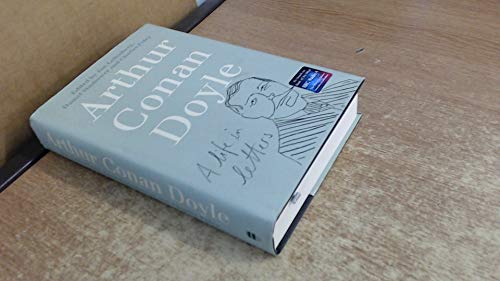
Two examples out of many: 1) In the discussion of the memoirs,
orchid314 left a very astute comment, saying that “a child of an alcoholic learns to conceal from an early age”. That’s precisely what happened: while in his memoirs ACD speaks openly about being severely beaten by the schoolmasters, in the letters he hardly ever mentions that something is amiss. On the contrary, he constantly assures his mother that everything is all right and asks her not to worry. One good reason for that was the teachers reading their pupils’ letters, but ACD must have also keenly sensed the difficult situation at home (it was so dire that he had to stay at school for Christmas while other boys went home for vacation), and hence he spared his mother’s feelings.2) It is from the letters that one learns the true circumstances of ACD’s choosing literature over medicine, and that it was not for the lack of patients, but rather because of his exhaustion (as already mentioned in the previous post).
The book is also fascinating because one can trace how a child (with simplistic grammar, spelling errors, and naïveté) evolved into a youth, and then into a grown man. There one can see very human moments which help one perceive ACD not only as a literary figure, but as a living being who liked to have fun and could do silly things:
‘I went to a subscription ball the other night—such a lark!’ he told Lottie [his sister]. ‘I got as drunk as an owl by some mischance. I have a dim recollection that I proposed to half the women in the room—married and single. I got one letter next day signed “Ruby” and saying the writer had said “yes” when she meant “no”—but who the deuce she was or what she had said “yes” about I can’t conceive.’There are many behind-the-scenes aspects of writing Holmes stories, like an amazing piece of information that Jean Leckie [ACD’s second wife, but at the time his sweetheart whom he couldn’t yet marry] gave ACD an idea about the plot of EMPT and Holmes’s dramatic reunion with Watson. Some 4 years later ACD and Jean could unite too.
The poignant and heartbreaking letters of the WWI period gave me a sense of ‘immediacy’, and for the first time I could regard it not as a far away historical event but a real tragedy in the lives of many people. After reading this book I think that there is no better way to learn history than to touch it through the letters.
Some traits of ACD’s character I admired and some found perplexing to say the least. The complexity of his personality is especially vivid in the letters.


no subject
Date: 2019-05-27 01:39 pm (UTC)no subject
Date: 2019-05-27 01:46 pm (UTC)no subject
Date: 2019-05-27 03:35 pm (UTC)no subject
Date: 2019-05-27 03:45 pm (UTC)no subject
Date: 2019-05-27 05:27 pm (UTC)What traits of his did you find perplexing?
no subject
Date: 2019-05-27 06:31 pm (UTC)Perplexing traits... I really admire the young ACD: reckless, humorous, chivalrous (if occasionally patronising to women ¯\_(ツ)_/¯). But as he got older, got fame and money, weird stuff started to happen. I can’t understand his attitude to his children from the first marriage. He practically cut them off like a slice of bread, if not financially, then emotionally. He didn’t even invite them to the wedding, in spite of Jean’s wish to see them there. The freaking Edalji (the guy he had saved from being condemned unjustly) was one of the guests, but not Mary and Kingsley. ACD had delivered his firstborn Mary himself, and Kingsley was his spitting image.
Then this weird glorification of war, including WWI, in spite of so many losses to the family.
Then of course the spiritualist stuff. It seemed like he valued people more when they were dead than when they were alive because he didn’t even come to see Kingsley when Kingsley was dying, but afterwards he constantly “communicated” with Kingsley’s spirit.
I could go on about his progressing misogyny (even though he adored Jean), but better won’t XD
no subject
Date: 2019-05-27 08:18 pm (UTC)And I'm sad to hear that he treated the children of his first marriage so shabbily, although I have to admit I've seen it happen often enough, when one regrets the relationship with the children's mother -- which is in no way an excuse for it, of course, it's just a common pattern. And to hear that he was closer to Kingsley's "spirit" than he was with Kinglsey... *sigh* Well, it's easier to have a relationship with a fantasy than with a person, I suppose.
Considering his boosterism of war, have you read his apologia for the Boer War, Cause and Conduct? I lost a lot of respect for him over that. (My summary comments here; warning for war atrocities in the post itself.)
All in all, there's enough that I side-eye ACD for that I keep my feelings about the man entirely separate from my feelings about the Holmes stories; I find I'm happier that way.
Letters to the Press: I have no idea if it's available as an e-book, I'm sorry -- I have a library copy from the local university. ETA: Looking at the publisher's listing, it seems to be hardback only.
no subject
Date: 2019-05-28 05:40 am (UTC)As I read A Life in Letters, where he denies that the British did any atrocities, I wondered whether he said so because he didn’t see it with his own eyes or whether he was lying through his teeth. Turns out it was the latter.
One of the things which astounded me was that he regarded enlisting and participating in the Boer War as a pleasure trip. His mother did all she could to persuade him not to go, saying that he was the head and the bread-winner of their big family, and should he die there, the family would be in a tough place. He replied something like, oh, no, Mum, it’ll do me good because I’m having a midlife crisis, and this will not only invigorate me, but also make me more famous. And so he got away from his ailing wife, his frustrated mistress, and his numerous relatives with their demands. It’s mindboggling, but it did improve his spirits and bring him a title.
Yes, he was anti-suffrage. I was constantly perplexed why he treated women as childish beings who were to be protected and admired, but could never be on par with men. His mother raised him and his siblings single-handedly. His sisters were working abroad so that he could get education. Even his teachers Bell and Watson supported women rights by helping women to be trained as doctors. ¯\_(ツ)_/¯
As for ‘window-breaking furies’,
Conan Doyle strongly disapproved of the civil disobedience practised by some suffragettes, especially when it crossed over into occasional violence—as when sulphuric acid was poured through his front door’s letter-slot in retaliation for his opposition.
I’m not justifying violence, but people often go to extremes to be heard...
Perhaps he regretted his relationship with Louisa, who was ‘dear’ and never ‘darling’, yet he was depressed after her death. It’s difficult to guess about his motivations.
It’s a pity Letters to the Press are unavailable in digital format. Maybe someday they will appear on archive.org.