DEVI

Apr. 11th, 2020 07:51 pm
mightymads: (Default)
[personal profile] mightymads
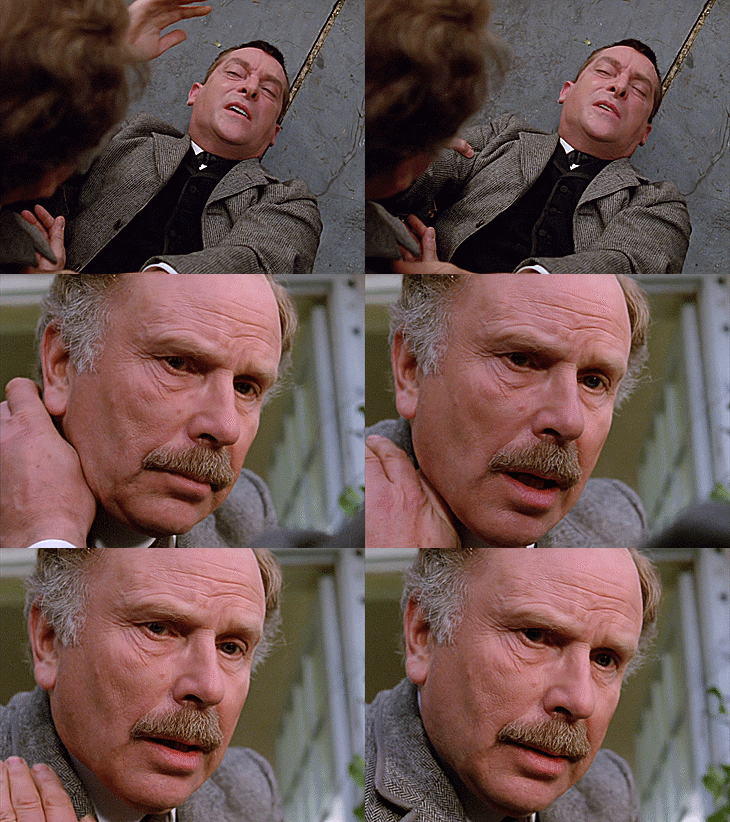
I was listening to a Bert Coules adaptation of DEVI again, and again the depth of Watson’s love and loyalty blew my mind away. Watson agrees to proceed with Holmes’s batshit crazy idea because he can’t talk Holmes out of it and wants to keep him safe. Watson would rather be poisoned too than let a convalescing Holmes expose himself to poison alone. I just ASCGHUJKL

Also a quick recap of things which were pointed out elsewhere:

- ACD and and his wife Jean had a holiday in Cornwall in 1910 (DEVI was published in December 1910) when ACD was recovering from a surgery and Jean was expecting their second child;
- DEVI features two lovers who can’t marry due to “the deplorable laws of England”: ACD and Jean could marry only after ten years of courtship after ACD’s first wife died. Also quite a parallel with Holmes and Watson;
- In Bert Coules version Holmes and Watson quote Wagner’s Tristan und Isolde when they are almost dying from poisoning:

“So let us die and never part
Together for the rest of time
No more waking
No more fearing
Nameless, endless,
Loving, sharing.”


- Holmes lets go of the man who avenged his beloved, saying that he’d basically do the same if someone killed a person he loved, and then, in 3GAR, “If you had killed Watson, you would not have got out of this room alive.”
mightymads: (Xmas-tinbox)
[personal profile] mightymads
A Study in Emerald, in all its iterations, is delightful. The graphic novel was a feast to the eyes, and it was fun to listen to Neil Gaiman reading, while the print version is available on Neil Gaiman’s website for free.

The world of the short story took me in instantly. It’s such a curious mirror universe where the world is ruled by Lovecraftian monsters. So in this case, loyal subjects of the Crown (the protagonists) are baddies while anarchists (the outlaws) are good. Both the narrative and the drawing style are exquisite.


The idea that Moriarty and Moran are Holmes and Watson’s mirrors is developed to its utmost. I especially enjoyed that in the graphic novel Moriarty and Holmes are lookalikes.


Also, A Study in Emerald must have influenced Petr Kopl’s graphic novels because there is a similar way of introducing small skits as funny advertisements between the chapters.

And then there is a paragraph which can rival with the canon in its romantic tension between the two protagonists, when the consulting detective says to his companion:

“I have a feeling that we were meant to be together. That we have fought the good fight side by side, in the past or in the future, I do not know. I am a rational man, but I have learned the value of a good companion, and from the moment I clapped eyes on you, I knew I trusted you as well as I do myself. Yes. I want you with me.”

The companion fully reciprocates:

“I blushed, or said something meaningless. For the first time since Afghanistan I felt that I had worth in the world.”

Another point: the circumstances of the murder seem to be a reference to Jack the Ripper.

Of course there are numerous parallels with STUD and SCAN and references to other cases, but it’s the ending I liked the most. Just as in SCAN, the detective is outwitted by his adversary. In SCAN Irene Adler flees with her husband Godfrey Norton, while in this story Holmes escapes with Watson and writes to Moriarty something like “too late, but you played well”.

mightymads: (opera)
[personal profile] mightymads
Warning: heavy spoilers

Last Holmestice I read [personal profile] sanguinity’s gripping piece called Tea for Two, with no prior knowledge of this novel. The premise drew me in so much that I added Moriarty to my reading list at once.

Before I begin my rant, I must say that the book is very entertaining. It took me two evenings to read it. What’s more, I found it rather satisfying that the questions asked in the first chapter about inconsistencies of Watson’s Reichenbach reports were covered by my headcanons.

Read more... )

mightymads: (Default)
[personal profile] mightymads
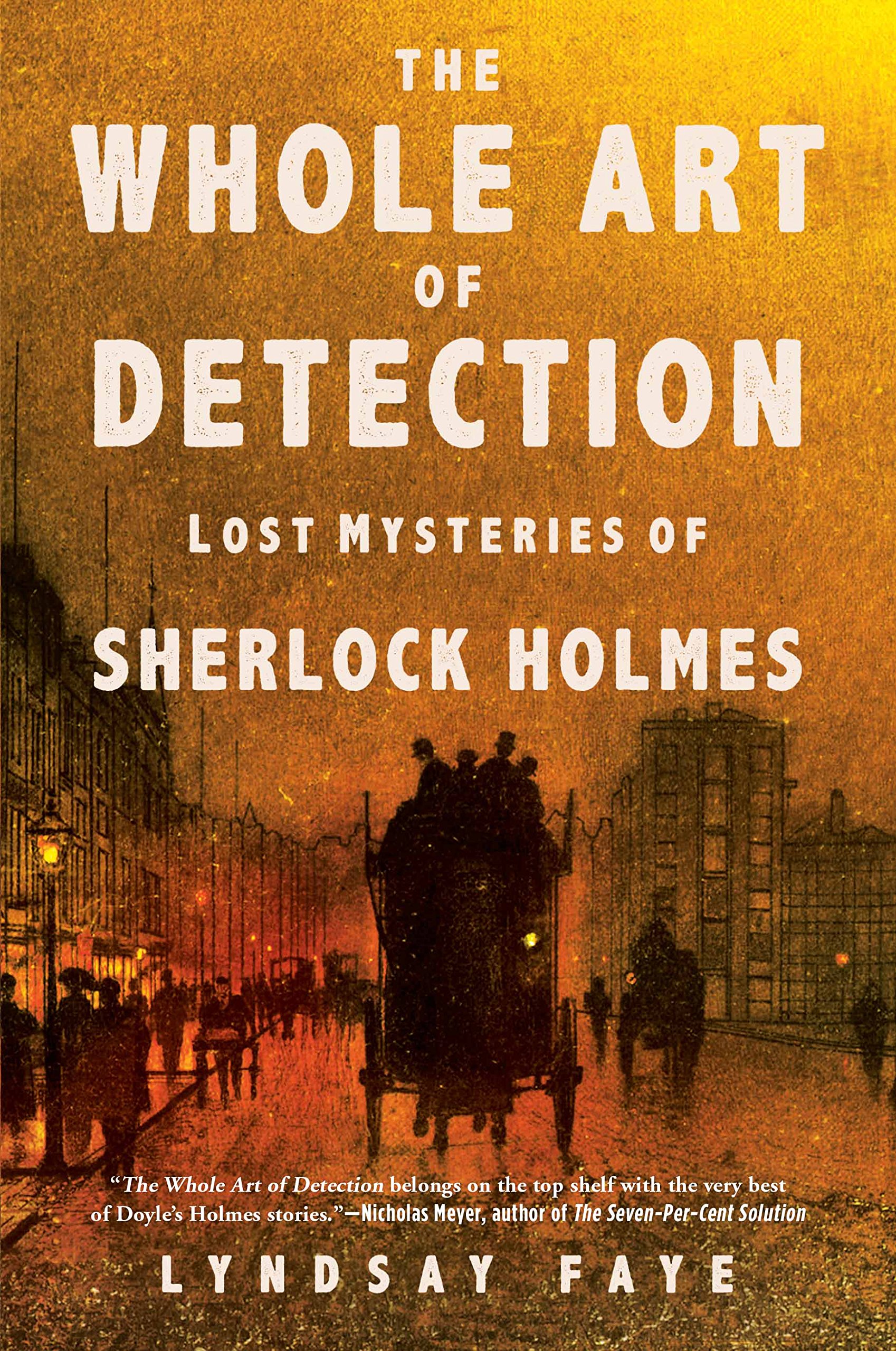
This last week of mad summer I’m catching up with reading and the Victorian Holmes community. As promised, a review for another book by Lyndsay Faye. The Whole Art of Detection was written after Dust and Shadow, and while earlier stories retain the enthusiasm and passion which are palpable in the novel, it seemed to me that by the second half of the book the author lost her zeal. The stories are divided into four periods: Before Baker Street, The Early Years, The Return, and The Later Years.

I was absolutely delighted by the first two sub-collections. The Case of Colonel Warburton’s Madness is the opening story, and it’s Faye’s take on an untold tale mentioned in the canon. There is another version in the Bert Coules series, and I can’t pick which I like better—for me both are equally strong and entertaining. Some goodgreads reviews mentioned that Faye’s story is a bit historically inaccurate. It may be so, but the story isn’t any less enjoyable because of that. We all remember the occasions in the canon when Holmes entertains Watson by anecdotes of his early years. This time it’s Watson who distracts Holmes from ennui by presenting him with a conundrum the doctor was wondering about for years.

The next story is The Adventure of The Magical Menagerie which offers us a glimpse of young Sherlock honing his craft and meeting Sherman the bird-stuffer, owner of Toby from SIGN. Sherlock in his early twenties is such an adorable minx that it’s an absolute highlight of the tale.

The Adventure of The Vintner’s Codex is also a reminiscence of Holmes’s younger days, and the plot is very good, quite in the spirit of the canon.

While The Adventure of The Honest Wife is in the best traditions of the canon too, simultaneously it has a feminist theme which is more of a nod to our time.

Memoranda Upon The Gaskell Blackmailing Dilemma is similar to The Honest Wife, its theme being a woman pushed into a miserable marriage, and the plot is not quite fresh, but the story is delightful for another reason I’ve already mentioned in the previous post.

Starting from the post-Reichenbach era, the pastiches go downhill, I’m afraid. Plots are thinner and characterisations don’t always work for me. However, the atmosphere of John’s loneliness and his state of mind are done well. There are hardships of the reunion and John mourning Mary, so if your headcanons coincide, you might like many moments.

As for the final part of the book, frankly, I just skimmed through it. The stories seem to have lost all their flair. I’m especially partial to older Holmes and Watson, but there was none of the Sussex goodness either. Perhaps Faye didn’t have the passion by the end or it was directed into other creative channels.

All in all, I had a nice impression of the book. Differences from ACD’s style are plentiful, and it seems that characterisations are often influenced by films and TV-series (Granada and Rathbone Holmes in particular) rather than by the canon only, but I had a good time and now feel much refreshed.

mightymads: (Default)
[personal profile] mightymads
So I’m reading Lyndsay Faye’s The Whole Art of Detection, a collection of Holmes pastiches, and it’s wonderful. A proper review will follow, but for now some live-blogging.

There’s a story written from Holmes POV, Memoranda Upon The Gaskell Blackmailing Dilemma, in which Holmes is working on a blackmailing case, having sent Watson away with Sir Henry to Dartmoor. Holmes fretting and missing his Watson and worrying about him is precious. I’ll just leave some of this goodness here:

I wish the doctor were here. His advice would be invaluable—gallantry, thy name is Dr. John H. Watson. For all he was too thin and far too rootless and melancholy, he may as well have stepped down off a white charger that day at St. Bart’s years ago.”

“I found that he had neglected to pack his woolen muffler, despite the fact it is nearly October. Is this the act of a prudent medical practitioner? Honestly, he can be very trying at times.
I gave it to Mrs. Hudson to send by the first post on the morrow.”

“I hope his revolver is in his pocket. I told him never to be without it, and he generally follows my instructions, but a hound (whether supernatural or the common garden variety) can tear a man’s throat out.”

“Also, if Watson is dedicated to writing me detailed reports, then by God I am going to read them.”

“It fast approaches midnight. All is in readiness. Mrs. Hudson has finally retired, after accusing me of “pining”.”
👌👌👌👌👌
mightymads: (holmeswatson)
[personal profile] mightymads
I finally read it and I loved it! Differences in style with ACD are quite obvious, but it didn’t make the book less enjoyable. Great characterisations: of Holmes, Watson, Lestrade, Mrs. Hudson, Mycroft, and OCs such as Mary Ann Monk. There are many wonderful moments between Holmes and Watson: taking care of each other when wounded, fighting street gangs back-to-back, running in dark alleys holding hands, bickering when either is in danger, Watson admiring Holmes’s boxing skills and Holmes saluting Watson with an ode on the violin... Mycroft’s trusting Watson completely in regards of Sherlock’s health rang just true as did Mrs. Hudson’s occasional exasperation with both of her lodgers. I really appreciated that not only Watson but Holmes also is chivalrous towards ladies. That’s true to the canon, and what’s even better than the canon, they are never condescending to Miss Monk, who helps them with the investigation of the Ripper case.

I had an impression that Holmes’s image was much influenced by Jeremy Brett’s acting: his exclamations, his moving gracefully, his vulnerability—again and again it reminded me of Jeremy. Watson reading his Holmes just as he does in the canon was a joy.

A special point of amusement for me was the eternal question of Watson’s marriage/engagement. By the time the book ends, he is supposed to know Mary, but she is never mentioned, and there is no indication that Watson is courting her or going move out from the Baker Street rooms.

Another detail which worked for me very well is Lestrade being Holmes and Watson’s staunchest friend and never doubting Holmes even when there are seemingly good reasons for that.

The way the “dramatic introduction” of Moore Agar was portrayed was also nice. While I have a different headcanon, that Agar is older and had more opportunities to study than Watson (since Watson consults him in DEVI and Agar’s word is final in convincing Holmes to take a vacation), Agar’s being a young doctor recently in practice was an interesting take in this story.

Journalists getting in the way of the investigation was one more detail I enjoyed. In the canon Holmes is on top of the game handling the press, so in this story it was quite realistic that Holmes can’t always be in control.

Mary Ann Monk is a great character, a lady on par with the male leads and not a Mary Sue. She is well-drawn and fleshed out. I enjoyed reading about her and her interaction with Holmes and Watson.

Numerous subtle nods to the canon were endearing. Some Victoriana aspects, like a point of wearing/not wearing gloves, were a special treat, a bonus.

The grand reveal and the denouement seemed a bit underwhelming to me but still very good. I’d like more insight into the Ripper’s persona and his motivations.

Anyway, now I have in mind to read a Holmes short story collection by Lyndsay Faye, so maybe another review will follow.
mightymads: (Default)
[personal profile] mightymads
Life is still hectic, but this fandom is the gift that keeps on giving. Yesterday I saw this on tumblr:


Someone mentioned in a comment to the post that it was from a Russian animation which made my search very easy. A few minutes later I was watching the mini-series on YouTube.

The giffed scene is from Sherlock Holmes and Doctor Watson: The Murder of Lord Waterbrook (2005), and this first installment is hilarious. There are numerous references to Lenfilm Holmes—it’s kind of a parody. The humour was a joy: sometimes absurd, sometimes slapstic, but very tastefully done. Also, a Holmes/Watson shipper will love this episode especially!


Read more... )
rachelindeed: Havelock Island (Default)
[personal profile] rachelindeed

Hi, everyone! I decided to watch the Geoffrey Whitehead Holmes series for Holmestice this summer (if anyone wants to read my off-the-cuff reaction post, it's over here), and I wound up also reading Sanguinity's lovely Holmes/Watson, and Holmes & Watson, fics set in that 'verse (so sweet! so sexy! so marmalade-laden! something for all tastes!)

Largely inspired by her stories, and the BOATLOADS OF SIGNIFICANT GLANCES the characters constantly share throughout the series, I made a little vid to celebrate the flirty joyful fun of this Holmes/Watson pair. If you'd care to check it out, here's the link:

[Vid] I'm a Sucker for You (0 words) by rachelindeed
Chapters: 1/1
Fandom: Sherlock Holmes and Doctor Watson (TV 1980)
Rating: General Audiences
Warnings: No Archive Warnings Apply
Relationships: Sherlock Holmes/John Watson
Characters: Sherlock Holmes, John Watson
Additional Tags: Fanvids, Whitehead Holmes series, Signficant Glances, Fluff and Humor
Summary:

A light-hearted, shippy vid for Whitehead's Holmes and Pickering's Watson. They deserve a little fun :)

mightymads: (Default)
[personal profile] mightymads
Just watched this short film and would like to discuss it. I won’t give any spoilers, though :) First, it was amazing to actually see John and Sherlock depicted as a couple straightforwardly, not only visualising it after reading the Canon or watching particularly charged moments of Granada or Lenfilm. Mrs. Hudson was hilarious, but the way Mary was treated was somewhat disappointing for me, to be honest. I understand that they did it for laughs, but I thought she was going to be a beard or something if they decided to introduce her into this version at all. Anyway, the microscope cake was funny and the Sussex references very endearing because retirementlock is my special jam. Also, A. J. Raffles' balloons XD 
graycardinal: Alexis Castle, thoughtful (Alexis (thoughtful))
[personal profile] graycardinal
I have been reading a number of pastiches lately, several of which feature female Holmes relatives, and it seems a good moment to make some quick comparisons and contrasts.

Colleen Gleason's The Clockwork Scarab is the first of five YA novels featuring MIna (never "Avermina") Holmes and Evalina Stoker.  Mina is Sherlock's niece and Mycroft's daughter (!); she gets along better with Sherlock, and has inherited and honed the family deductive acumen.  Evalina is Bram Stoker's daughter, here given a family lineage and minor superpowers essentially replicating those of television's Buffy.  "Here" is an alternate steampunk England in which electricity has been found too dangerous to use and thus outlawed as an energy source, and Mina and Evalina subsequently find themselves invited to work for a covert royally chartered investigative service overseen by Irene Adler (!!) out of an office in the British Museum (!!!), and drawn into the schemes of the Ankh, a mysterious figure determined to resurrect the goddess Sekhmet and thereby establish dominion over England (at least).

The Disappearance of Alistair Ainsworth is the third in a series by Leonard Goldberg featuring Joanna, Sherlock Holmes' daughter via Irene Adler (never seen and virtually unmentioned in this volume).  Holmes himself has been deceased for some years, and by now Joanna is the widow of a Dr. Blalock, the mother of his precocious son (here visiting from Eton), and the wife of Dr. John Watson Jr. (!).  Watson Sr. is still living, Joanna and her family reside at 221b, and the group's present case involves a brilliant cryptanalyst kidnapped by German agents, from whom they are tasked to find and rescue him.

The Enola Holmes series by Nancy Springer postulates a younger sister for Sherlock and Mycroft, raised at home by her mother until said mother disappears just as Enola turns fourteen.  Over the course of six slim chapter books (Amazon calls this series YA, but these are shorter and pitched at a younger readership than the Gleason series), Enola runs away from her country home, establishes herself in London, solves several moderately complex mysteries -- including the kidnapping of Dr. Watson -- and effectively runs rings around both Sherlock's and Mycroft's attempts to find her and pack her off to boarding school...a fate which Springer and her heroine persuasively argue would have been almost literally worse than death.

****

I bounced hard off of the Enola Holmes books on the first pass, some years ago -- as I recall, I thought the tone a bit too sermon-like, the pacing slow, and Enola too clever to be believable.  On a second, much more recent encounter, I almost completely changed my mind.  There's definitely an educational agenda here, but it's one that's both worthwhile and more effectively presented than I gave it credit for the first time around.  [It may well also be true that the series was published a few years ahead of its time; Enola's brand of feminism is far less strident now than it may have seemed then.]  And Springer does a superb job of developing her characters -- not excluding Mycroft and Sherlock, who are very much their canonical selves and not (as often happens in alternative Holmesiana) reduced in intellect to allow the author's protagonist to shine more brightly.

By rights, I ought to have bounced off the Gleason series, which is very much alt-Holmesiana and fashionably steam-powered.  But Gleason makes no apologies for the novelty, the world-building is sketched very lightly but logically, and the plotting is admirably brisk.  Not even the introduction of a time-traveling teen from non-steampunk 2016 (!!!!) seriously derails the overall credibility.  This is more action-adventure than deductive exercise (though Mina does pretty well at the latter art), but it's fun in the right ways, and the two leads are excellent foils for one another.

I did bounce off the Goldberg novel, which I cannot recommend (and I am faintly astonished that this series has survived and evidently prospered).  Goldberg is not a bad prose-mimic -- or perhaps he's too skilled a mimic for his own good.  But there is no extrapolation here at all; this is a plain Holmes case through and through, and Goldberg does the absolute minimum in terms of changing the template, to the extent that it complicates the narration considerably.  Joanna is always "Joanna", never "Holmes", and in making Watson's son (and fellow doctor) narrator, Goldberg forces far too many references to "my father" and other circumlocutions in order for readers to keep all the characters straight. Worse still, Joanna's son is also named "Johnny" despite not being a Watson, and to make matters even stranger, Joanna herself is the namesake of one Joanna Blalock, series protagonist in an unrelated series of modern medical thrillers also written by Goldberg. Almost everyone talks in the same general voice, there's much too much conversation and not enough deduction, and aspects of the central mystery take Joanna herself much too long to solve.  This is cardboard Holmes -- and would have been better used as the basis for a straight Holmes pastiche rather than a next-generation yarn.

mightymads: (Default)
[personal profile] mightymads
A new fill for the Victorian Holmes kinkmeme! A prompt by [personal profile] luthienberen:
 
Alpha/Omega

Holmes (Alpha) decides to show to his Omega (Watson) how much he missed him and to also soothe any remaining unruffled feathers for deceiving Watson. (Fluff and/or more intimate).

Set during or after the Hound of the Baskervilles films (one of the two Rathbone films set in the Victorian era).

Smelling Salts (Rathbone | E | 2.2K) by [personal profile] stonepicnicking_okapi - After the Baskerville case, Watson goes into heat.
graycardinal: Alexis Castle, thoughtful (Alexis (thoughtful))
[personal profile] graycardinal
A Study in SableA Scandal in BatterseaThe Bartered Brides
Mercedes Lackey (published by DAW Books)

The first thing to know about Mercedes Lackey's contributions to the world of Sherlockian pastiche is that these are not really Sherlock Holmes stories as such -- that is, Holmes himself is a secondary (or even tertiary) character, with Dr. Watson and his wife (specifically, Mary Morstan Watson) taking stronger secondary roles.  The true leads are Nan Killian and Sarah Lyon-White, two orphaned young women who have lately come into their powers as a psychic and a spirit medium (yes, really) respectively, and are now living more or less independently under the auspices of a White Lodge of wizards based in London.  Their origins and several prior adventures are chronicled in earlier volumes of Lackey's "Elemental Masters" series, of which this Holmesian sequence is now a major subset.  It isn't especially necessary to have read the non-Holmesian installments to jump in at this point in the larger series, but new readers should be cautioned that this is definitely a fantasy universe -- both young women have talking birds as companions, and among their allies is no less than Shakespeare's "Puck", here played as a sort of British analog to Coyote or Raven, the trickster/Changer/guardian figures of many Native American cultures.

Second, these are not strictly even detective stories as such, at least not primarily of the whodunit school -- rather, these follow the mode in which we as readers alternate following our heroes as they pursue investigations and our villains as they plot and carry out their diabolical plans, leading up to a final confrontation in which (because these are Elemental Masters books) there is a dramatic magical battle of some kind.  (Do not, repeat do not, attempt to diagram an Elemental Masters novel according to any conventional standards of How Plots Work.  You will end up staring at your page or monitor screen and wondering how Lackey gets away with it.  Trust me on this.)

And yet....

Lackey gives us a truly fascinating portrayal of the Watsons -- specifically, she makes both John and Mary highly trained Elemental Masters (he's Water, she's Fire), and sets them up as mentors to the series' main leads.  Fans of competent!Watson (and competent!Mary) will find much to like here, and no small amusement in Sherlock Holmes' ongoing mild annoyance at living in a world where magic works, however little he likes having to admit it.  At the same time, the portrayal of Holmes himself is respectful and pretty much canon-consistent, if a trifle distant by fanfictional standards -- this last not surprising, since one thing we get very little of here is Holmes' own narrative point of view.

And The Bartered Brides -- set specifically in the period immediately following Holmes' reported demise at Reichenbach -- pulls several extremely inventive twists on key canonical matters.  There's the scheme to resurrect Moriarty from the dead (perfectly possible in Lackey's magical landscape), the formation of an alliance between our heroines' sponsors' White Lodge and a certain Mycroft Holmes (not a wizard, but totally willing to make use of wizardly resources), and a startling but wholly reasonable workaround to the problem of Watson's multiple wives.

Verdict?

Lackey is perhaps best known for writing ultra-competent protagonists whom some readers find entirely too good to be true, and these books do fit that pattern. OTOH, Sherlock Holmes himself is something of the prototypical Mary Sue (Marty Stu?), so that's not necessarily a drawback here.  At the same time, the single weakest aspect of the Elemental Masters series is that its villains tend to be one-note stick figures, and that's a bit more of a difficulty in this cluster.  On the plus side, though, the overall worldbuilding -- both in general and with specific respect to the Holmesian elements -- is solidly developed, and there is a great deal of room here for fanfic writers to explore should they choose to do so.

On the whole, I give these a cautious recommendation.  There will be readers who can't get past Lackey's particular narrative and storytelling tics, and that's OK...but for what they are, I like these books and am looking forward to the next installment.

luthienberen: (Default)
[personal profile] luthienberen
Dinosaurs! Octopus. Steampunk! Cybermen!

This is just a short review of the Sherlock Holmes 2010 film which basically has a steampunk twist to it. Yes, it is as bizarre as it sounds. :) Apologies for the lack of pictures – I am not entirely sure how to grab them? I presume screenshots, so I will try with the next film I review…


My rambling thoughts behind the cut )
mightymads: (Default)
[personal profile] mightymads
I've recently watched Murder by Decree (1979) with Christopher Plummer and James Mason, a Sherlock Holmes vs Jack the Ripper movie which has a subdued thriller-like atmosphere (as one would expect) and a most human Holmes (a pleasant surprise). After that I just had to compare it with an earlier Ripper installment, and I liked it even more.


Read more... )
mightymads: (holmeswatson)
[personal profile] mightymads
Anyone who saw the films and the series, share your impressions? Cushing certainly has the looks of Holmes. His Holmes is a reserved thinker, masterful and occasionally short-tempered.

So far I liked best the first Holmes installment he did, The Hound of the Baskervilles (1959). The dynamic with Watson (Andre Morell) is beautiful: Watson is a competent helpmate whom Holmes respects and values. The good doctor is a partner in every sense of the word: they share glances and smiles, often don't need words to understand each other, and work as a team, even when apart. Basically, as they do in the books.


Read more... )
mightymads: (Default)
[personal profile] mightymads
[personal profile] stonepicnicking_okapi posted a wonderful fic a few days ago

Gang Aft Agley (G, 5K, Basil/Dawson), where Dawson is abducted, Basil is to the rescue, and it turns out to be connected with the Giant Rat of Sumatra.

I enjoyed it so much that I went and watched The Great Mouse Detective the very same evening. I wish I grew up with it! There was even a nice nod to the 1954 Ronald Howard series.


After watching, I realised that the fic is really like a sequel: the characters are spot on, the original characters are depicted very vividly, there is a charismatic villain, and the whole adventure is absorbing. I had a great time reading this story!
mightymads: (holmeswatson)
[personal profile] mightymads


In the previous post [personal profile] iwantthatcoat and [personal profile] luthienberen recommended graphic novels. In addition to those I found one more. Reviews for the three and enlarged images are under cut :)

Read more... )
iwantthatcoat: (Default)
[personal profile] iwantthatcoat
Has anyone else seen these? I love them to death—esp the ending of Final Problem,

Profile

victorian221b: 221b (Default)
Victorian 221b

February 2023

S M T W T F S
   1234
567891011
12131415161718
19 202122232425
262728    

Syndicate

RSS Atom

Most Popular Tags

Style Credit

Expand Cut Tags

No cut tags
Page generated Mar. 29th, 2026 04:53 am
Powered by Dreamwidth Studios