Film rec: They Shall Not Grow Old (2018)
Dec. 19th, 2019 10:25 am![[personal profile]](https://www.dreamwidth.org/img/silk/identity/user.png) mightymads posting in
mightymads posting in ![[community profile]](https://www.dreamwidth.org/img/silk/identity/community.png) victorian221b
victorian221bThe human perspective is one of the best ways to learn history, and this stunning documentary by Peter Jackson is a must-see! The film was created from the original WWI footage, colorised, digitally restored, and with voice over by the WWI veterans themselves. Jackson, whose grandfather served during WWI, intended the film to be an immersive experience, and that’s what it most definitely is.
Through the fragments of interviews woven into a unified narration, the Great War ceases to be something distant, far removed in time. It is possible to sense it as a part of lives of those whose voices tell the story, and much becomes clearer.
Reading Arthur Conan Doyle: A Life in Letters, I was baffled by the fact that ACD continued to glorify the war despite losing his son, his brother, his nephew, and brothers-in-law. However, in this film, some veterans, even looking back after many years, speak of the war as something admirable:
“I can only say one thing, I wouldn’t have missed it. It was terrible at times, but I wouldn’t have missed it.”
“Oh yes, if I could have my time again, I’d go through it all over again because I enjoyed service life.”
“I could only say that I have never been so excited in my life, this was like a boy going to the play for the first time.”

Not all veterans shared that point of view, and many said that it was a horrible, ghastly business, but the words quoted above astonished me and made me judge ACD less harshly.
Despite that the drafting age was 19-35 years, many enlisted being just teenage boys of 16-17. They lied about their age, so motivated they were by encouragement from the government and the general mood. Some women were as unsympathetic to those who wouldn’t enlist due to age or other reasons that they handed white feathers to everyone they considered shirking cowards.
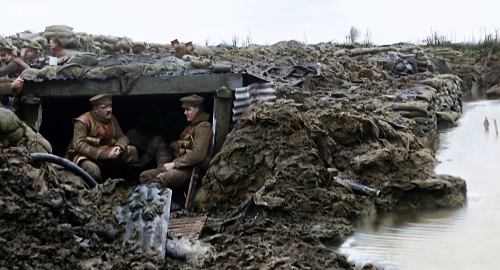
Before watching this film, I was aware that working-class people were underfed and had more health problems than middle and upper classes even before WWI:
...they were weedy, sallow, skinny, frightened children. The refuse of our industrial system and they were in very poor condition and had to be made into soldiers.
The war made them do what they were ordered to do, although very often they didn’t feel any personal animosity towards Germans:
“A lot of the German troops, they were very good, very friendly. In fact, some if those Bavarians were damned good, decent people. The snipers would fire but not hit anybody, you know what I mean.”
Some parts are very graphic in description of battles and deaths. I won’t quote them here, but they convey the horror and pointlessness of war.
Listening about the medical staff held a special interest to me, of course:
“We had some remarkable doctors who worked day and night in various stations on the British front, looking after the wounded.”
“They seemed never to need any sleep, so what they hadn’t got in numbers they made up in effort.”
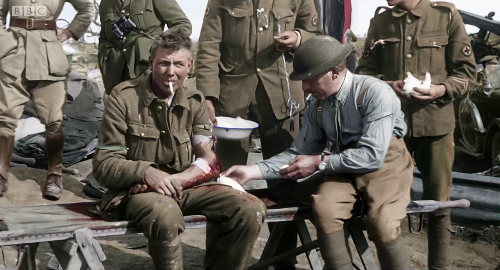
By the end of the war both sides were tremendously exhausted.
“As the war went on, I felt as much sympathy for them as I did for myself.”
“They didn’t seem to bear any malice against us. They’d had to do what they were told, like us.”
“The general agreement when we were talking to Germans was how useless war was and why did it have to happen.”
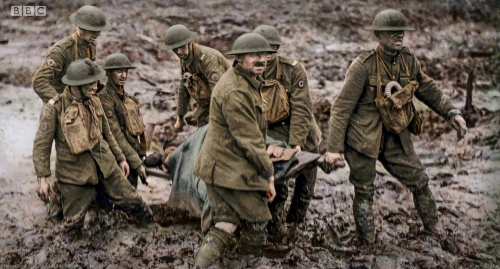
It was shocking to learn how those who survived were treated when they returned back to Britain. There is a grim parallel with the veterans of the Vietnam War in the US and Soviet-Afghan War in the USSR when few seemed to care or understand what those men had been through.
“I was horrified by what I saw when I came back here and when one tried to get a job.”
“There was mass unemployment, and I thought, “This isn’t much of a life.””
“It was a shame, the way ex-servicemen were treated. You weren’t wanted. Some places said, “No ex-servicemen need apply,” and that was the sort of attitude you were up against.”
“People never talked about the war. It was a thing that had no conversational value at all. Most people were absolutely disinterested.”
“And there was no reason why any of us millions should have been favoured with a thank you very much for having got a little bit muddy and out of touch with good manners.”
“We were race apart from the civilians, and you could speak to your comrades, and they understood, but the civilians, it was just a waste of time.”
“However nice and sympathetic they were, attempts of well-meaning people to sympathise reflected the fact that they didn’t really understand at all.”
“The only thing that really did annoy me was when I went back to work, [...] and the bloke behind the counter was a bloke who I knew. He said, “Where have you been? On nights?”
There is so much more I’d like to quote, but better go get this film and watch it. I think this is what must be shown at history lessons at school.

Through the fragments of interviews woven into a unified narration, the Great War ceases to be something distant, far removed in time. It is possible to sense it as a part of lives of those whose voices tell the story, and much becomes clearer.
Reading Arthur Conan Doyle: A Life in Letters, I was baffled by the fact that ACD continued to glorify the war despite losing his son, his brother, his nephew, and brothers-in-law. However, in this film, some veterans, even looking back after many years, speak of the war as something admirable:
“I can only say one thing, I wouldn’t have missed it. It was terrible at times, but I wouldn’t have missed it.”
“Oh yes, if I could have my time again, I’d go through it all over again because I enjoyed service life.”
“I could only say that I have never been so excited in my life, this was like a boy going to the play for the first time.”
Not all veterans shared that point of view, and many said that it was a horrible, ghastly business, but the words quoted above astonished me and made me judge ACD less harshly.
Despite that the drafting age was 19-35 years, many enlisted being just teenage boys of 16-17. They lied about their age, so motivated they were by encouragement from the government and the general mood. Some women were as unsympathetic to those who wouldn’t enlist due to age or other reasons that they handed white feathers to everyone they considered shirking cowards.
Before watching this film, I was aware that working-class people were underfed and had more health problems than middle and upper classes even before WWI:
“Victorian commentators themselves noticed a difference in height among the contemporary population, with many people noting how much smaller, at every age, working-class people were than the upper classes. Several newspaper and magazine articles point to a four-inch height difference between a twelve-year-old Etonian and a twelve-year-old lad from the East End of London. It takes a lot of hunger to do that to people.”
“The nation was shocked by the appalling levels of unfitness in the young men who volunteered in 1899 [for the Second Boer War], with only two out of every nine being judged fit for combat.”
—How to Be a Victorian by Ruth Goodman
“Yet after 50 years of supposed ‘nutritional improvements’, the British army recruiting for the Boer war at the turn of the century found around 50% of young working class recruits to be so malnourished as to be unfit for service.” (source)From this film I found out that on the eve of WWI the situation was hardly any better:
...they were weedy, sallow, skinny, frightened children. The refuse of our industrial system and they were in very poor condition and had to be made into soldiers.
The war made them do what they were ordered to do, although very often they didn’t feel any personal animosity towards Germans:
“A lot of the German troops, they were very good, very friendly. In fact, some if those Bavarians were damned good, decent people. The snipers would fire but not hit anybody, you know what I mean.”
Some parts are very graphic in description of battles and deaths. I won’t quote them here, but they convey the horror and pointlessness of war.
Listening about the medical staff held a special interest to me, of course:
“We had some remarkable doctors who worked day and night in various stations on the British front, looking after the wounded.”
“They seemed never to need any sleep, so what they hadn’t got in numbers they made up in effort.”
By the end of the war both sides were tremendously exhausted.
“As the war went on, I felt as much sympathy for them as I did for myself.”
“They didn’t seem to bear any malice against us. They’d had to do what they were told, like us.”
“The general agreement when we were talking to Germans was how useless war was and why did it have to happen.”
It was shocking to learn how those who survived were treated when they returned back to Britain. There is a grim parallel with the veterans of the Vietnam War in the US and Soviet-Afghan War in the USSR when few seemed to care or understand what those men had been through.
“I was horrified by what I saw when I came back here and when one tried to get a job.”
“There was mass unemployment, and I thought, “This isn’t much of a life.””
“It was a shame, the way ex-servicemen were treated. You weren’t wanted. Some places said, “No ex-servicemen need apply,” and that was the sort of attitude you were up against.”
“People never talked about the war. It was a thing that had no conversational value at all. Most people were absolutely disinterested.”
“And there was no reason why any of us millions should have been favoured with a thank you very much for having got a little bit muddy and out of touch with good manners.”
“We were race apart from the civilians, and you could speak to your comrades, and they understood, but the civilians, it was just a waste of time.”
“However nice and sympathetic they were, attempts of well-meaning people to sympathise reflected the fact that they didn’t really understand at all.”
“The only thing that really did annoy me was when I went back to work, [...] and the bloke behind the counter was a bloke who I knew. He said, “Where have you been? On nights?”
There is so much more I’d like to quote, but better go get this film and watch it. I think this is what must be shown at history lessons at school.


no subject
Date: 2019-12-20 04:11 am (UTC)no subject
Date: 2019-12-20 04:21 am (UTC)no subject
Date: 2019-12-20 05:31 am (UTC)Something I thought really interesting from it was how it made me think a bit differently about appeasement before WW2. Because today, it's so easy to indict that idea, that maybe war could have been avoided by negotiating with Hitler. But it's also really easy to forget how individually and collectively traumatized the world was by WW1 at that point. And hearing those voices say that they came home and didn't really understand what they had been fighting and dying for, that nothing seemed to be any different, that they hadn't done any actual good-- well, of course those people would absolutely refuse the prospect of another war.
The thing about their treatment upon returning home was really heartbreaking too-- and, wrong period of history again here, but reminded me of this tumblr post I had to go dig up and re-read, because it's what of the most incredible things I've ever read: Soviet women's stories of fighting in WW2. Particularly, that by that time, the attitude towards men returning home from war was positive, they were eligible heroes. But the women, who fought in exactly the same units and roles as the men, were regarded as dirty and ruined.
no subject
Date: 2019-12-20 06:36 am (UTC)Thank you so much for the Tumblr link too! It was heartbreaking to read. Women's input into the Great Patriotic War is recognised and revered in Russia, but I learned this side of things for the first time.
I highly recommend a Soviet film called "The Dawns are Quiet Here" about an all-female unit which protected a strategically important position. They were all volunteers, very young, barely from school or university. They accomplished their mission successfully but at a tragic cost. Here it is dubbed in English: watch on YouTube
UPD: That tumblr post is a fragment from the book called The Unwomanly Face of War. I found it in Russian, and then was surprised that there is actually an English translation too.
no subject
Date: 2019-12-20 08:05 pm (UTC)Oh wow, thank you so much! The person who translated it on tumblr seemed to think there wasn’t one already— I’ll definitely look that up.