Ranks and uniforms
Mar. 14th, 2020 06:48 pm![[personal profile]](https://www.dreamwidth.org/img/silk/identity/user.png) mightymads posting in
mightymads posting in ![[community profile]](https://www.dreamwidth.org/img/silk/identity/community.png) victorian221b
victorian221bInstead of adulting I spent the day trying to make sense of the convoluted medical system in the British army at the time Watson served in Afghanistan. Glad to say that I think I did and now more or less I am sure what uniform Watson possessed as a memento from the army. It’s going to be a long post with a lot of text, references, and pictures, so everyone interested is welcome under cut.
Let’s start with quoting the opening sentences of STUD again: “In the year 1878 I took my degree of Doctor of Medicine of the University of London, and proceeded to Netley to go through the course prescribed for surgeons in the army. Having completed my studies there, I was duly attached to the Fifth Northumberland Fusiliers as Assistant Surgeon.”
Some researchers wondered why Watson never mentions his army rank. In fact, he does! Assistant Surgeon was an equivalent of Lieutenant in the ranking system of the Army Medical Department. However, according to Wikipedia, that was before 1873. Starting from 1873 the lowest rank a Medical Officer could be assigned was Surgeon, and it still was an equivalent of Lieutenant. With formation of the Royal Army Medical Corps in 1898, when a major reform of the medical service in the British army took place, ranks of medics were unified with those of combatants:

This means that ACD could be somewhat inaccurate and his knowledge on the military doctors' ranks could be out of date. On the other hand, I'm no historian and maybe ACD didn't make a mistake.
According to Doctors in the Great War by Ian R. Whitehead, before RAMC there were two medical services in the British army: the Army Medical Department (Medical Officers, i.e. trained doctors with degrees who also went through a military surgery prep course at Netley) and the Army Hospital Corps (stretcher bearers, orderlies, and nurses also instructed at Netley).
“The Army Hospital Corps had no officers; the Medical officers, still attached to the regiments, but without any authority in them, had no men. The Army Medical Department was an administrative office, separate from either of the executive branches of the medical service, and virtually incapable of exercising any influence over them.”
Basically, Medical Officers—doctors—had no authority over their orderlies which is kind of crazy. Another source about the Army Medical Corps confirms this:
"Medical officers had no authority over the men of the Army Hospital Corps. The entire control over all orderlies and the whole distribution of the duties of male hospital attendants, and the responsibility for the manner in which the duties were performed in general military hospitals, were vested in the Captain of Orderlies who was responsible for the performance of his duties to the governor and commandant. Medical officers might require the hospital attendants to do certain duties in the way of watching, dressing, or nursing patients and the attendants might or might not do them according to the directions given. According to the army regulations, medical officers not satisfied with the work of the orderlies had to complain to the Captain of Orderlies, who would investigate the complaint, and dispose of it according to his own views and judgment."
"The men of the AHC had been initially recruited from soldiers in infantry regiments. Men generally joined the Army Hospital Corps after two to three years' military service and had to undergo a probationary period of six months before being accepted into the corps. Men of the AHC who had originally volunteered from other regiments and who wished to remain with the Corps on the completion of the first period of their limited engagement had to re-engage."
The Army Hospital Corps even wore a uniform which differed from that of Medical Officers:


(Soldiers of the Army Hospital Corps who served in the Anglo-Egyptian War, c.1882, see source for the entire photograph)
Whereas Medical Officers who were attached to their regiments must have worn uniforms of their regiments. Look at the photo of Surgeon-Major Alexander Francis Preston:

"Among those wounded at Maiwand was an army doctor, Surgeon-Major Alexander Francis Preston. His experiences so closely mirror those of Dr Watson, he is thought to be the model for Holmes’s sidekick. The Berkshire regiment (the 66th) arrived in Kandahar at the beginning of 1880, with their medical officer, Surgeon-Major Preston. Surgeon-Major Preston was near the front. A bullet passed through his back, just missing his spine, and he was taken to the rear. Unlike Watson, who became a civilian, Preston rejoined the army and served in Hong Kong, China and Ireland, rising to Surgeon General. He retired in 1902 and became Edward VII’s honorary physician. It seems he never married and he died in 1909, aged 64." (Daily Mail)
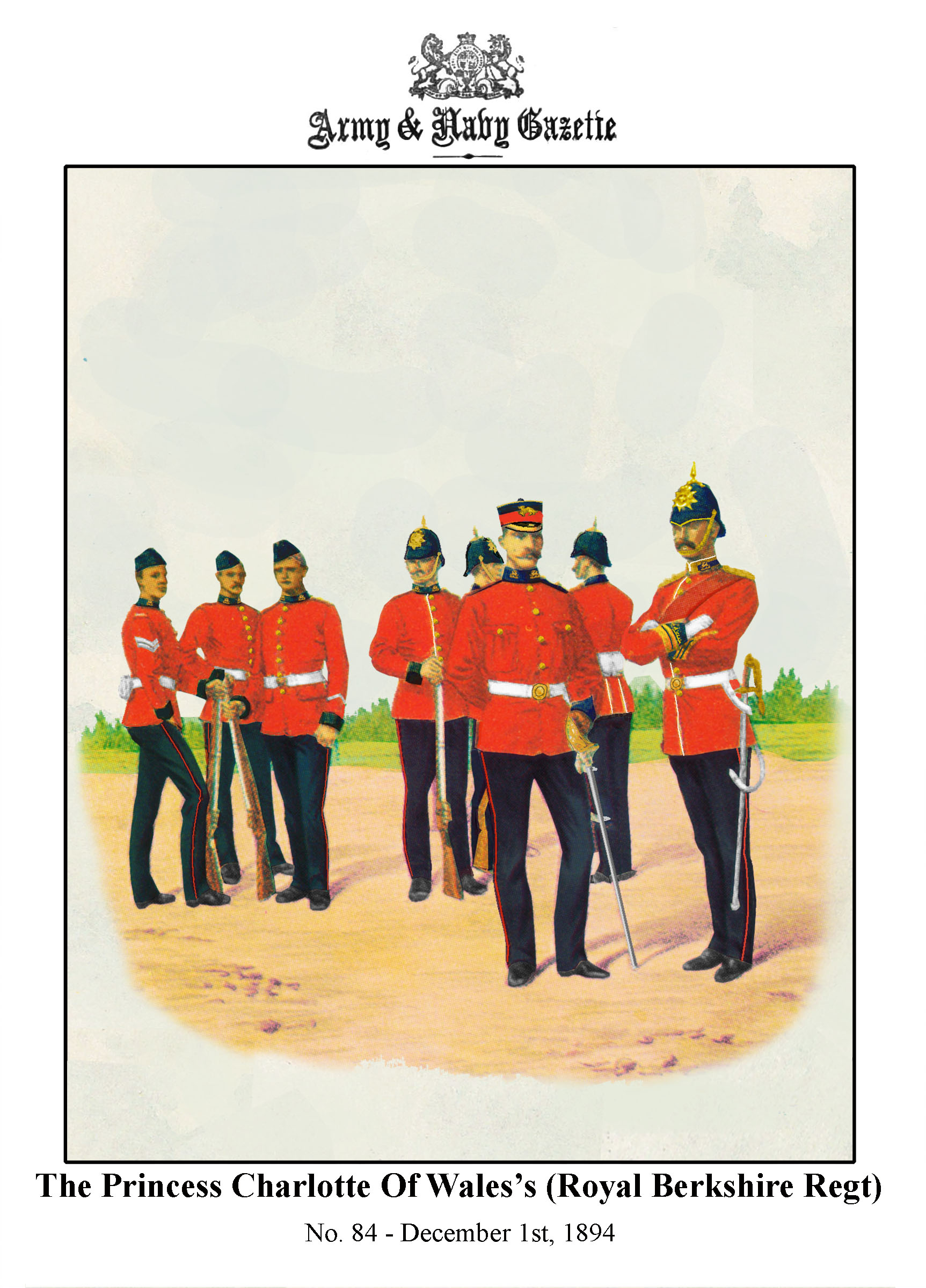
And this is the uniform of the Royal Berkshire Regiment (uniformology.com):

66th Regiment in England before leaving for India: Battle of Maiwand on 26th July 1880 in the Second Afghan War: picture by Harry Payne (britishbattles.com):
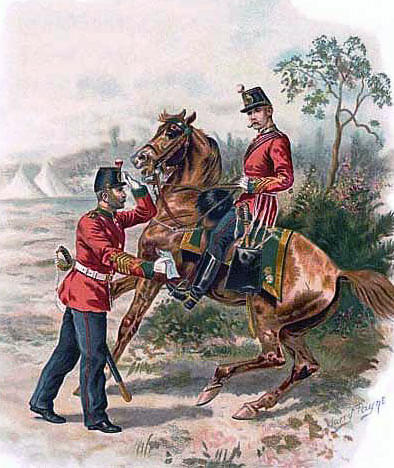
Preston's uniform is obviously like that of the Berkshires. Hence, I suppose, Medical Officers wore uniforms of the regiments they were attached to.
It's also worth noting that in field conditions a less conspicuous khaki-coloured uniform was worn:

(found on pinterest)
Last stand of the ‘Eleven’ from the 66th Regiment at the Battle of Maiwand on 26th July 1880 in the Second Afghan War: picture by Harry Payne (britishbattles.com):
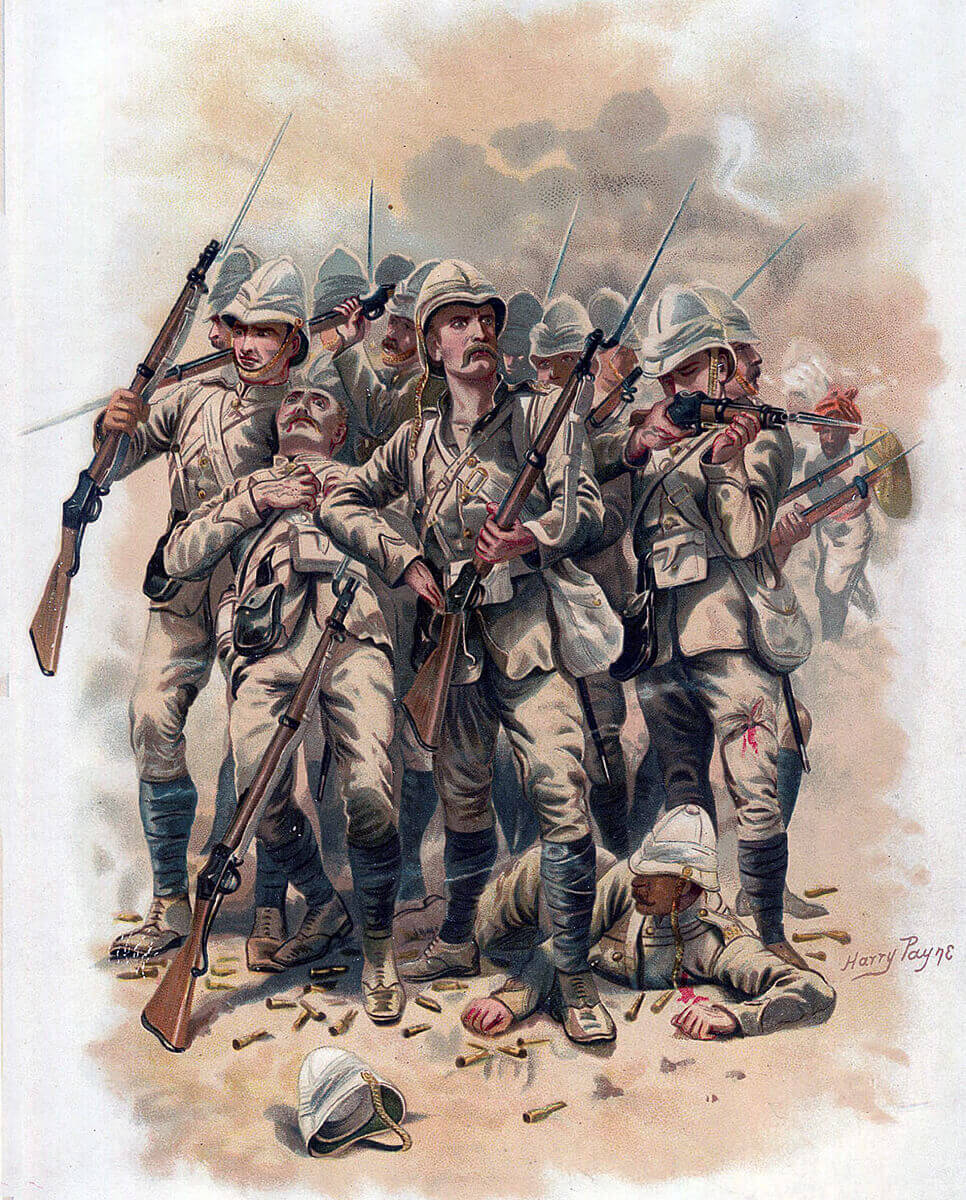
In 1884, when Watson had already returned to civilian life, The Army Medical Department was renamed into The Army Medical Staff and its officers given command over the Medical Staff Corps (the former Army Hospital Corps), so Medical Officers received some authority. In 1898 RAMC was formed. It united both services, and at last there was a clear authority structure within the corps itself and in relation to the combatant departments.
Let’s start with quoting the opening sentences of STUD again: “In the year 1878 I took my degree of Doctor of Medicine of the University of London, and proceeded to Netley to go through the course prescribed for surgeons in the army. Having completed my studies there, I was duly attached to the Fifth Northumberland Fusiliers as Assistant Surgeon.”
Some researchers wondered why Watson never mentions his army rank. In fact, he does! Assistant Surgeon was an equivalent of Lieutenant in the ranking system of the Army Medical Department. However, according to Wikipedia, that was before 1873. Starting from 1873 the lowest rank a Medical Officer could be assigned was Surgeon, and it still was an equivalent of Lieutenant. With formation of the Royal Army Medical Corps in 1898, when a major reform of the medical service in the British army took place, ranks of medics were unified with those of combatants:
This means that ACD could be somewhat inaccurate and his knowledge on the military doctors' ranks could be out of date. On the other hand, I'm no historian and maybe ACD didn't make a mistake.
According to Doctors in the Great War by Ian R. Whitehead, before RAMC there were two medical services in the British army: the Army Medical Department (Medical Officers, i.e. trained doctors with degrees who also went through a military surgery prep course at Netley) and the Army Hospital Corps (stretcher bearers, orderlies, and nurses also instructed at Netley).
“The Army Hospital Corps had no officers; the Medical officers, still attached to the regiments, but without any authority in them, had no men. The Army Medical Department was an administrative office, separate from either of the executive branches of the medical service, and virtually incapable of exercising any influence over them.”
Basically, Medical Officers—doctors—had no authority over their orderlies which is kind of crazy. Another source about the Army Medical Corps confirms this:
"Medical officers had no authority over the men of the Army Hospital Corps. The entire control over all orderlies and the whole distribution of the duties of male hospital attendants, and the responsibility for the manner in which the duties were performed in general military hospitals, were vested in the Captain of Orderlies who was responsible for the performance of his duties to the governor and commandant. Medical officers might require the hospital attendants to do certain duties in the way of watching, dressing, or nursing patients and the attendants might or might not do them according to the directions given. According to the army regulations, medical officers not satisfied with the work of the orderlies had to complain to the Captain of Orderlies, who would investigate the complaint, and dispose of it according to his own views and judgment."
"The men of the AHC had been initially recruited from soldiers in infantry regiments. Men generally joined the Army Hospital Corps after two to three years' military service and had to undergo a probationary period of six months before being accepted into the corps. Men of the AHC who had originally volunteered from other regiments and who wished to remain with the Corps on the completion of the first period of their limited engagement had to re-engage."
The Army Hospital Corps even wore a uniform which differed from that of Medical Officers:
(Soldiers of the Army Hospital Corps who served in the Anglo-Egyptian War, c.1882, see source for the entire photograph)
Whereas Medical Officers who were attached to their regiments must have worn uniforms of their regiments. Look at the photo of Surgeon-Major Alexander Francis Preston:
"Among those wounded at Maiwand was an army doctor, Surgeon-Major Alexander Francis Preston. His experiences so closely mirror those of Dr Watson, he is thought to be the model for Holmes’s sidekick. The Berkshire regiment (the 66th) arrived in Kandahar at the beginning of 1880, with their medical officer, Surgeon-Major Preston. Surgeon-Major Preston was near the front. A bullet passed through his back, just missing his spine, and he was taken to the rear. Unlike Watson, who became a civilian, Preston rejoined the army and served in Hong Kong, China and Ireland, rising to Surgeon General. He retired in 1902 and became Edward VII’s honorary physician. It seems he never married and he died in 1909, aged 64." (Daily Mail)
And this is the uniform of the Royal Berkshire Regiment (uniformology.com):
66th Regiment in England before leaving for India: Battle of Maiwand on 26th July 1880 in the Second Afghan War: picture by Harry Payne (britishbattles.com):
Preston's uniform is obviously like that of the Berkshires. Hence, I suppose, Medical Officers wore uniforms of the regiments they were attached to.
It's also worth noting that in field conditions a less conspicuous khaki-coloured uniform was worn:
(found on pinterest)
Last stand of the ‘Eleven’ from the 66th Regiment at the Battle of Maiwand on 26th July 1880 in the Second Afghan War: picture by Harry Payne (britishbattles.com):
In 1884, when Watson had already returned to civilian life, The Army Medical Department was renamed into The Army Medical Staff and its officers given command over the Medical Staff Corps (the former Army Hospital Corps), so Medical Officers received some authority. In 1898 RAMC was formed. It united both services, and at last there was a clear authority structure within the corps itself and in relation to the combatant departments.


no subject
Date: 2020-03-14 07:57 pm (UTC)no subject
Date: 2020-03-15 04:11 am (UTC)no subject
Date: 2020-03-15 10:52 pm (UTC)